


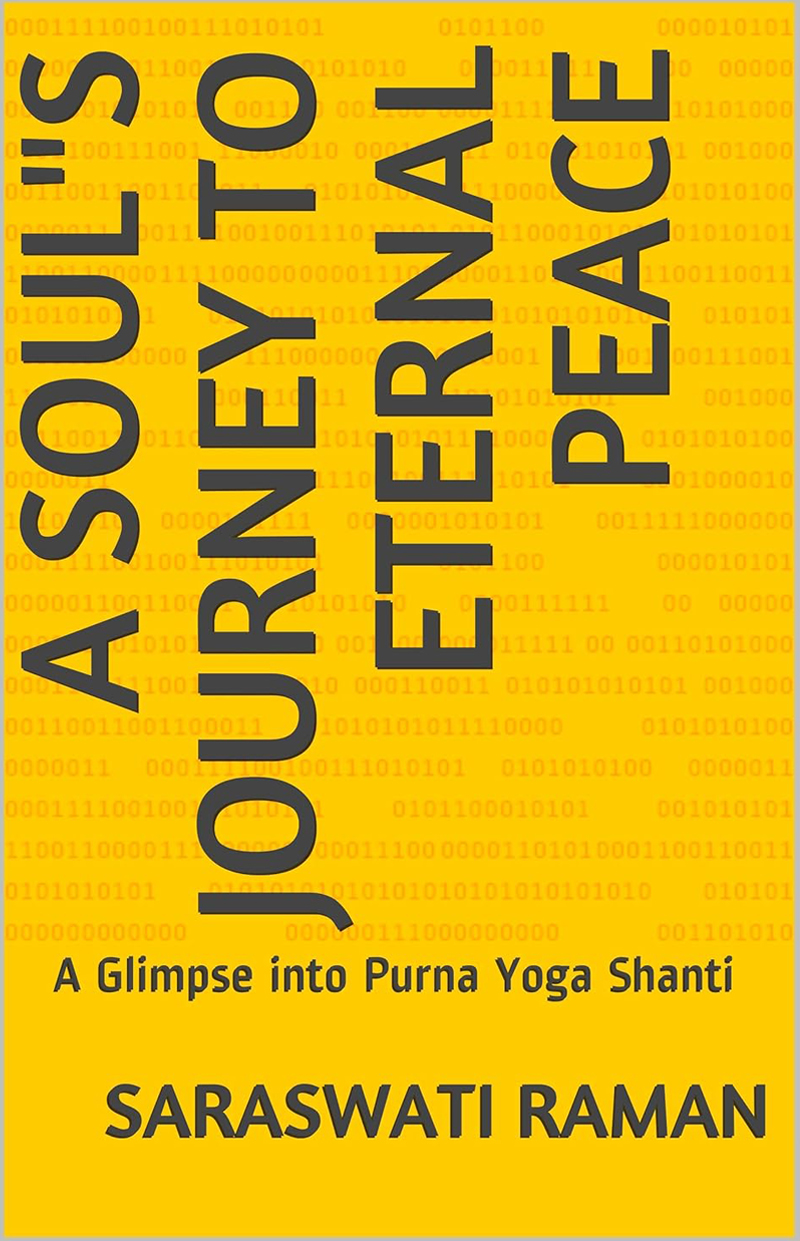
TThe book “A Soul’s Journey to Eternal Peace” by Saraswati Raman is an exploration of a Seeker beginning from the realms of the known and venturing into the unknown to discover a path of attaining Eternal Peace. We all wish for everyone who has died, “May the soul rest in ever lasting peace” but seldom are consciously aware of what it really signifies.
Saraswati Raman, in this book, “A Soul’s Journey to Eternal Peace” writes about the various realms which a soul enjoys according to his actions and spiritual practices that bestow upon him the appropriate fruits. Through a narration of the dialogue between Shri Ganaraja Prabhu and King Varenya wherein Shri Ganaraja Prabhu explains in detail the step by step procedure to be followed for actualization of the Divine by a seeker while still in the human body and how he can continue to live in the ordinary day to day life even after having experienced the Divine. The theme of the book is set in a situation where an ardent Seeker, Uma, has a vision in one of her meditations where she is transported to the scene of the dialogue which occurred many thousands of years ago as though having touched the Akashik records that brought the vision into a scene of reality. She goes on to narrate the process of self-actualization in the form of instructions on the path of yoga about the various components of the human being and how the same are to be tackled to reach the final goal of Purna Shanti. The human body is said to be composed of the physical body, the subtle body and the causal body. The soul or the Purusa exists in this vehicle when a human being is born. The physical body also known as the Annamaya Kosha, grows from the level of a fetus to a fully grown up after birth passing through various stages in life such as the childhood, youth, middle age and grown up man. The physical body or Annamaya kosha which contains the subtle body comprising of 24 principle energies such as the five sense organs, five organs of action, five pranas, five elements, the mind, ego, the intellect and the ahamkara. The Subtle body is the pure form or energetic basis wherein exist the seven chakras or astral centers with the force of Kundalini who is his primordial mother since innumerable lives. The subtle body consists of three Koshas or sheaths such as the Vijnyanamaya Kosha or the intellectual sheath, the Manomaya Kosha or the mental sheath and the Praanamaya Kosha or the vital energies sheath. The causal body is another subtle body within the subtle body which is called the Ananadamaya Kosha containing the energies of the three gunas, namely Sattwa, Rajas and Tamas. The bodies inter-relate with one another through the chakras, the seven energy centers and which connect to each other through the pranic fields of energy from 72000 nadis. When the seeker realizes his true Self (Atman) transcending the practice of physical gratification, he recognizes his essential nature to be Divine and he gets established in Brahman. He then lives each and every moment completely. He enjoys the wonder and beauty of each instant and begins to understand the infinite energy that manifests within. The seeker experiences the knowledge that is beyond the sense organs and sense objects. It is then that Divine powers or Siddhis are attained. In this way a yogi is endowed with knowledge of all three time frames. Man’s mind is constantly flowing outwards and experiencing the world of objects. This tendency of external flow of the mind has to be curtailed and made calm. This is through restraint of the tendencies of the mind. Prayer and contemplation are nothing but the destruction of the outward bound tendencies of the mind and the effort aimed at attaining stability of the mind. The main aim is to liberate one from Nature’s entanglements and sorrow and establish him in Self-Realization and Self-bliss.
